


The Propel Guide To EBT In Texas
Our editorial promise
All of our Propel editorial content meets our high bar for accuracy, timeliness, trust, and relevance. Our pages are edited and fact-checked to make sure we meet our mission of giving you information you can rely on.
Learn more about our editorial standards.Here's what you need to know about SNAP in Texas, from eligibility to renewals to using your Lone Star EBT card.
- How does SNAP work in Texas?
- How to apply for food stamps in Texas
- Who is eligible for SNAP in Texas?
- When are SNAP deposits issued in Texas?
- How do I renew my food stamps in Texas?
- What can I buy with EBT in Texas?
- Where are EBT cards accepted in Texas?
- What SNAP changes do I need to report?
- How do I report a lost or stolen EBT card in Texas?
- Frequently asked questions
Table of contents
- How does SNAP work in Texas?
- How to apply for food stamps in Texas
- Who is eligible for SNAP in Texas?
- When are SNAP deposits issued in Texas?
- How do I renew my food stamps in Texas?
- What can I buy with EBT in Texas?
- Where are EBT cards accepted in Texas?
- What SNAP changes do I need to report?
- How do I report a lost or stolen EBT card in Texas?
- Frequently asked questions
Here's what you need to know about SNAP in Texas, from eligibility to renewals to using your Lone Star EBT card.
SNAP, sometimes called food stamps or just EBT, can be an essential tool for low-income households in Texas to help supplement their grocery budget every month.
SNAP is federally funded and operates under national rules, but each state manages its own program under those guidelines. That means application steps, benefit schedules, renewal processes, and customer service details can vary depending on where you live.
Here’s what to know about EBT and SNAP benefits in Texas.
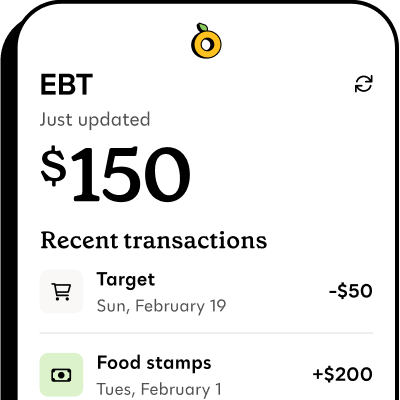
Propel is the #1-rated EBT balance checking app
How does SNAP work in Texas?#how-does-snap-work-in-texas
In Texas, about 3,470,000 people receive SNAP benefits.
If you’re looking for help covering groceries, SNAP provides monthly support through the Lone Star card (Texas’ EBT card). Your benefits are loaded onto the card each month and can be used at stores that accept food stamps.
After you apply, a caseworker from your local county office will typically contact you for a phone interview to verify details like your household size, income, and expenses.. Once your case is approved, benefits continue as long as you remain eligible and complete any required renewals.
How to apply for food stamps in Texas#how-to-apply-for-food-stamps-in-texas
There are several ways to apply for food stamps in Texas.
Apply for SNAP online
You can apply through the official state SNAP website below.
Apply for SNAP by phone or in person
If you need help applying or prefer speaking with someone, you can
- Call the Texas SNAP hotline at 1-877-541-7905 for information and guidance on how to apply in your county (some counties may allow you to apply by phone)
- Apply in person at a county or local benefits office
SNAP application assistance is also available through your local food bank.
What you’ll need to apply for SNAP#what-youll-need-to-apply-for-snap
When you apply, you’ll usually be asked for:
- Proof of identity
- Information about everyone in your household, like birthdays and immigration status
- Income details, like pay stubs or benefit letters from SSI, SSDI, or Social Security Retirement
- Housing and utility costs
You do not need every document to start an application; you can submit missing information later.
Who is eligible for SNAP in Texas?#who-is-eligible-for-snap-in-texas
SNAP eligibility is mostly determined by your household size and income, but some applicants may have to meet additional requirements.
In general, you may qualify for SNAP if:
- Your household income is at or below state limits
- You meet work requirements (if it applies to you)
- You are a U.S. citizen, or you meet immigration requirements
- Your assets are at or below the limit
When are SNAP deposits issued in Texas?#when-are-snap-deposits-issued-in-texas
SNAP benefits are sent out over the first 28 days of the month. For those certified after June 1, 2020 the date will be between the 16th and the 28th. For those certified before June 1, 2020, the date will be between the 1st and the 15th. Your exact deposit date depends on the last one or two digits in your Eligibility Determination Group (EDG) number.
Need to find your Eligibility Determination Group (EDG) number? Check your SNAP approval letter sent by your county or log into the Your Texas Benefits portal to find it under your case details.
If your SNAP deposit doesn't arrive when expected, review these common reasons why deposits are delayed.
Propel is the best way to see upcoming deposits, check your EBT balance, and turn on security features that help keep your benefits safe from theft.
How do I renew my food stamps in Texas?#how-do-i-renew-my-food-stamps-in-texas
SNAP benefits don’t last forever—you’ll need to renew your case (also called recertification) to keep getting them.
When to renew
Most households in Texas must renew every 6 months.
Households where all adults are elderly or disabled and there is no earned income must renew every 36 months.
Your SNAP office should send you a letter in the mail when it’s time to reapply. To be safe, you could also put a note in your calendar or wherever you keep important reminders.
How to renew
You can usually renew:
- Online through your Your Texas Benefits portal
- By phone
- By mail or in person
To find out the easiest way to renew in your area, call your caseworker, local office, or the Texas 2-1-1 SNAP hotline: 1-877-541-7905
What can I buy with EBT in Texas?#what-can-i-buy-with-ebt-in-texas
Under federal SNAP rules, you can use your Lone Star Card to buy most food items meant to be prepared and eaten at home.
While SNAP benefits are strictly for groceries and related food items, some people also receive TANF, which provides cash on an EBT card for household needs, including rent, bills, and other expenses.
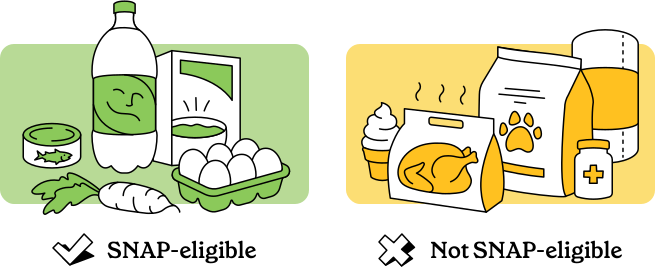
SNAP‑eligible foods in Texas include:
- Fruits and vegetables (fresh, frozen, dried, or canned)
- Meat, poultry, and fish
- Dairy products, like milk, cheese, and yogurt
- Bread and cereals
- Snack foods, like popcorn, chips, and pretzels
- Seeds and plants that grow food
- Drinks like juice (with 50% or more fruit or vegetable juice), water, and energy drinks
- Pantry staples like flour, olive oil, and spices
- Infant formula and baby food
What you can’t buy with SNAP in Texas:
- Alcohol, tobacco, or vapes
- Vitamins, supplements, and medicine
- Hot food that is sold prepared and ready to eat, like rotisserie chicken or soup from a deli
- Pet food
- Cleaning supplies and household items
- Diapers and wipes
- Live animals (except certain seafood and animals slaughtered before pickup)
Texas has restrictions in place starting in April 2026, which means there are certain things you can no longer buy with your SNAP benefits. This includes sweetened drinks like soda, but does not include milk-based drinks or drinks with 50% or more fruit or vegetable juice. Candy is also banned, but some items ARE NOT considered candy under the ban such as products used as baking ingredients (chocolate chips or sprinkles) and certain snack items, like granola bars, nuts, ice cream, and popcorn.
Where are EBT cards accepted in Texas?#where-are-ebt-cards-accepted-in-texas
You can use your Lone Star Card at:
- Grocery stores
- Convenience stores
- Farmers markets
- Some online retailers
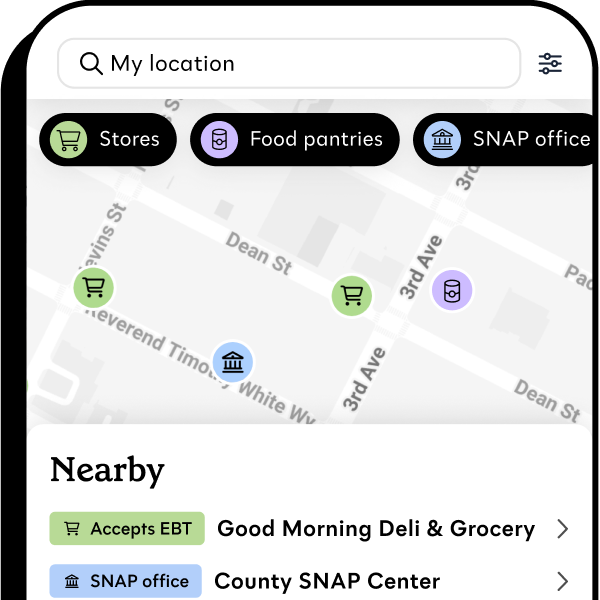
Download Propel to find nearby stores that take EBT, plus other Texas SNAP resources
What SNAP changes do I need to report?#what-snap-changes-do-i-need-to-report
You may be required to report changes to your SNAP case.
In Texas, most changes are reported during your regular SNAP recertification or renewal, but some changes must be reported sooner to help avoid delays or issues with your benefits.
Texas categorizes SNAP households as SR1, SR2, or SR3 which determines reporting requirements. If required, you must report changes within 10 days of knowing about the change.
Your household may get an SR1 and SR2 categorization if you are considered a low or medium income household with a stable income source. Your household may get an SR3 categorization if you know you might become ineligible within 6 months, have an "able-bodied adult without dependents" (ABAWD) household member with a history of not meeting work requirements, or your household has a shorter certification period (4 months or less).
Changes you should report as an SR1 or SR2 within 10 days:
- Income goes over the limit: If your household's total gross monthly income goes over 130% of the federal poverty level (FPL) for your household size, for two months in a row
- Work hours drop: If you are an ABAWD and your work or training hours drop below 20 hours per week
- Lottery or gambling winnings: If someone in the household wins $4,250 or more from the lottery or by gambling
Changes your should report as an SR3 within 10 days:
- Address or housing costs change: If you move, or if your rent, mortgage, or utility costs change
- Income source changes: If you start, stop, or change a source of earned income (work) or unearned income (such as Social Security or unemployment)
- Wages or work status changes: If your pay rate changes, or your job status changes between full-time and part-time
- Unearned income changes by more than $125: If your household’s gross monthly unearned income changes by more than $125 during your certification period
- Household changes: If someone moves in or out of your household, or there is a new baby
- Child support obligations change: If you become legally required to pay child support to someone outside your household or the amount changes
- Resources reach $5,000 or more: If your available cash, stocks, bonds, or money in bank accounts total $5,000 or more
- Vehicle ownership changes: If someone in your household gets or owns a licensed vehicle that must be reported
- Work hours drop: If you are an ABAWD and your work or training hours drop below 20 hours per week
- Lottery or gambling winnings: If someone in the household wins $4,250 or more from the lottery or by gambling
Changes that can be reported during recertification (may not all apply to SR3 households):
- Household changes: If someone moved in or out of your household, or there was a new baby
- Address changes: If you moved or your mailing address changed (though it's usually a good idea to report this right away so SNAP can contact you by mail)
- Housing costs changed: If your rent, mortgage, property taxes, homeowners insurance, or utility costs changed
- Job changes: If someone started a job, lost a job, or changed employers
- Wages or hours changed: If someone’s pay rate, salary, or work hours changed
- Unearned income changes: If benefits like Social Security, unemployment, pensions, or child support changed
- Medical expenses: If a household member who is elderly or has a disability has new or higher medical costs
- Child support payments: If the amount of legally obligated child support you pay changed
- Resources changed: If your cash, bank account balances, or other countable resources changed
- Vehicle changes: If someone bought, sold, or gained access to a vehicle that must be reported
How to report changes
To report a change, you can do one of the following:
- Use the Your Texas Benefits portal
- Call your local SNAP or Health and Human Services Commission (HHSC) office
- Call your caseworker
- Call 2-1-1 or 1-877-541-7905
- Fill out a change report form Form H1019, Report of Change or Form H1028, Employment Verification and send it by mail Texas Health and Human Services Commission, PO Box 149024, Austin, TX 78714-9024; or fax to 1-877-447-2839
If you’re unsure whether a change needs to be reported right away, contacting your SNAP office is the safest option.
How do I report a lost or stolen EBT card in Texas?#how-do-i-report-a-lost-or-stolen-ebt-card-in-texas
If your Lone Star Card is lost, stolen, or damaged, you should report it as soon as possible so you can get a new one and protect yourself from EBT theft.
Here's what to do:
- Call the Texas Lone Star Card Help Desk phone number 1-800-777-7328
- Follow the prompts to cancel your card or request a replacement
Frequently asked questions#frequently-asked-questions
Can I get any discounts with my EBT card?#can-i-get-any-discounts-with-my-ebt-card
Yes. In Texas, your Lone Star Card can unlock discounts and perks like:
- Free or reduced price entry to museums like the Houston Museum of Natural Science and more through Museums for All. Find participating museums nationwide.
- Double Up Food Bucks Texas, which can match your SNAP spending dollar for dollar on fruits and vegetables at participating Texas farmers markets, farm stands, mobile markets, and grocery stores.
You can even qualify for low–cost internet and discounted memberships to online retailers, like Amazon or Walmart.
You can explore more nationwide perks by viewing our list of everything you can get for free with EBT.
Can I use my SNAP benefits at restaurants in Texas?#can-i-use-my-snap-benefits-at-restaurants-in-texas
No, in Texas, you generally cannot use SNAP benefits to buy hot, prepared food or to eat at restaurants.
While some states have a Restaurant Meals Program for the elderly, disabled, or those experiencing homelessness, Texas does not participate in this program.
You can only use your Lone Star Card at authorized retailers (like grocery stores and farmers markets) for food items intended to be prepared and eaten at home.
Can I get more food stamps if I’m pregnant or a new parent?#can-i-get-more-food-stamps-if-im-pregnant-or-a-new-parent
Yes, once your child is born, you should report your new family member to your county. More household members mean more benefits.
If you're pregnant or have a child under five years old, consider applying for the WIC program, which gives you extra benefits on top of food stamps—including things like support with breastfeeding and extra grocery benefits.
Can I use my EBT card in another state?#can-i-use-my-ebt-card-in-another-state
Yes, your Lone Star Card works in all 50 states, as well as most U.S. territories, at any store displaying the Quest® symbol or EBT/SNAP/food stamps accepted sign.
Keep in mind that while your Lone Star Card will work nationwide, some states have restrictions that may prevent you from using SNAP benefits to buy items like soda or candy at local stores.
Using your card exclusively outside of Texas for an extended period may trigger a residency review by your SNAP agency. If you move to another state permanently, you must close your Texas SNAP case and reapply in your new state to keep receiving benefits.
What other benefits are available to me in Texas?#what-other-benefits-are-available-to-me-in-texas
In addition to SNAP, you may qualify for other programs that help cover basic needs, including:
- Temporary Assistance for Needy Families (TANF): Cash assistance ( Cash EBT) and workforce training opportunities
- Women, Infants, and Children (WIC): Extra food assistance, breastfeeding support, and nutrition or health screenings for pregnant women, new moms, and children under age five
- National School Lunch Program (NSLP): Free or reduced price school meals for children and Summer EBT for cash food assistance during non-school months
- Medicaid and the Children's Health Insurance Program (CHIP): Free or low-cost healthcare or discounts for private health plans in the Health Insurance Marketplace
- Child care assistance programs like Head Start and other free or low cost childcare options
- Energy or utility assistance programs like LIHEAP
- Housing support programs like like Section 8 housing vouchers and emergency assistance
- And many more services through exploring the Texas HHS Search Services tool
The best way to find out what you qualify for is to apply through the Your Texas Benefits portal or talk to a local caseworker, services office, or community agency. You can also call 2-1-1 or 1-877-541-7905.